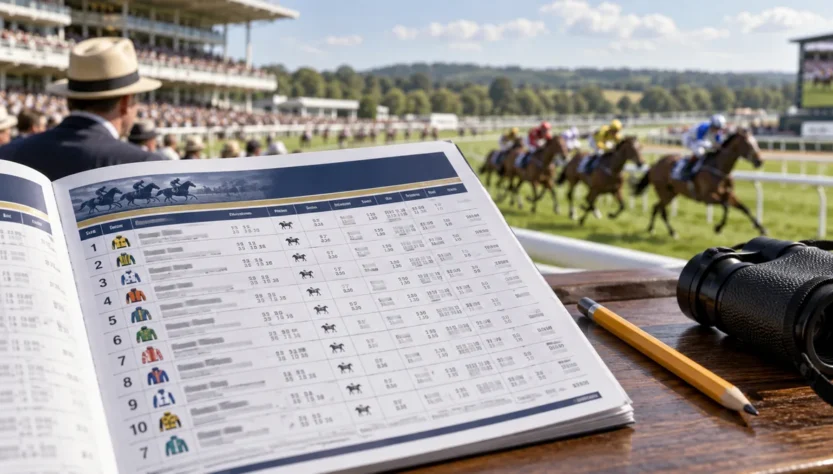
A horse racing racecard contains the main information about every race and runner on a meeting. At first it can look crowded with numbers, letters, weights, ratings and abbreviations. Once you know what each section means, however, the card becomes a practical guide for comparing horses and understanding the conditions of a race.
This beginner-friendly guide explains how to read a horse racing racecard step by step. You will learn how to interpret form figures, distance, going, draw, weight, jockey and trainer information, ratings, equipment and odds. Racecards vary between countries and racing providers, so always check the legend on the card you are using.
What Is a Horse Racing Racecard?
A racecard is a race-day information sheet. It lists the scheduled races and the horses entered in each event. A useful card helps you answer basic questions: When does the race start? How far will the horses run? What surface and going will they face? What weight will each horse carry? How has each runner performed recently?
Start With the Race Information
Race distance
Distance matters because horses can be suited to different tests. Some show their best speed in short sprints, while others perform better over middle or longer distances. A horse that finished strongly at a similar distance may be more relevant than one whose best results came in a very different type of race.
Race class or grade
Class describes the standard of competition. Terminology differs by racing jurisdiction, but a move into a stronger class can make the task harder, while a drop in class can make a runner more competitive. Do not judge class in isolation; consider form, distance, surface and current condition together.
How to Read Horse Racing Form Figures
Form figures summarize a horse’s recent finishing positions, usually with the newest result at one end according to the card’s convention. For example, a sequence such as 4-2315 shows several recent results. The hyphen may separate seasons or calendar years.
| Symbol | Common meaning |
|---|---|
| 1, 2, 3 | Finished first, second or third |
| 0 | Finished tenth or worse |
| F | Fell |
| P or PU | Pulled up |
| U or UR | Unseated rider |
| R | Refused |
| BD | Brought down |
Abbreviations are not completely universal, so use the provider’s legend. More importantly, figures need context. A fifth-place finish in a strong race could be better than a win against weaker opposition. Check the distance, going, class, field size and margin rather than relying on the finishing number alone.
Course and Distance Indicators
Many racecards use short indicators beside a horse’s name. C normally means the horse has won at the course, D means it has won over the distance, and CD means it has won over the same course and distance.
What Does “Going” Mean in Horse Racing?
The going describes the condition of the racing surface. On turf, common descriptions include firm, good to firm, good, good to soft, soft and heavy. Synthetic surfaces use different labels. Weather can change the going before race time, so check for official updates.
Understanding the Draw
The draw is the starting-stall position, used mainly in flat racing. A low or high number is not automatically good or bad. Its effect depends on the course layout, race distance, number of runners, location of the first turn and current track conditions.
Horse Number and Saddlecloth Number
The large number beside a runner usually identifies the horse and its saddlecloth. Depending on the jurisdiction, it may also relate to betting displays or race ordering. Do not confuse this number with the draw: the horse number and stall number can be different.
Weight Carried by the Horse
A racecard shows the weight a horse is required to carry, including the jockey and equipment under the race rules. In a handicap, the assigned weights are intended to balance the runners based on their assessed ability.
Higher weight does not automatically mean a horse cannot win. Consider the difference between runners, the distance, ground conditions and whether an apprentice jockey claims a weight allowance. Small differences may matter more in a demanding race than in an easier or shorter contest.
Jockey and Trainer Information
The jockey controls pace, position and timing during the race. The trainer prepares the horse and chooses suitable races. Racecards may show recent strike rates, course records or other statistics for both.
Horse Racing Ratings
Ratings are numerical assessments of performance or ability. A card may display an official rating, a speed figure, a private performance rating or several different numbers. Because rating systems use different methods and scales, compare like with like.
Days Since the Previous Race
Many cards show how long it has been since a horse last raced. A quick return may suggest fitness but can also raise a recovery question. A long break may mean the horse is fresh, although it may need the run. Trainer patterns and previous performances after similar breaks can provide useful context.
Headgear and Equipment
Racecards may note blinkers, a visor, cheekpieces, a hood or a tongue tie. These items can be used to improve concentration, comfort or breathing. A first-time equipment change is worth noticing, but its effect is uncertain until the horse competes with it.
Understanding the Odds
Odds show the market’s view and determine the potential return under the operator’s rules. Shorter odds suggest stronger market support, while longer odds suggest a lower perceived chance. Prices can move as more information and money enter the market.
The favourite does not always win, and odds are not a substitute for reading the race conditions. For a separate explanation, see our beginner’s guide to reading horse racing odds.
Example of Reading a Racecard Entry
Assume today’s going is good. This entry shows useful recent form and proven course-and-distance ability. The draw appears manageable, and the break is not unusually long. You would still compare the class, pace, ratings, jockey, trainer and rivals before reaching a conclusion.
A Simple Racecard Checklist
- Confirm the race time and venue.
- Read the distance and race conditions.
- Check the class or grade.
- Review each horse’s recent form.
- Compare course and distance history.
- Match past results with today’s going.
- Consider whether the draw matters here.
- Compare weights and any allowances.
- Review jockey, trainer, ratings and layoffs.
- Check late changes before race time.
Common Racecard Mistakes
- Choosing a horse from its latest finishing position alone.
- Assuming a low draw is always an advantage.
- Ignoring changes in distance, class or going.
- Comparing ratings from different systems as if they are identical.
- Treating a favourite as a guaranteed winner.
- Forgetting to check withdrawals, jockey changes or updated conditions.
If you are new to the process after reading a card, our guide on how to place your first online horse racing bet explains the next steps in plain language.
Frequently Asked Questions
What do the numbers on a horse racing racecard mean?
They usually show recent finishing positions. Other numbers can represent the horse number, draw, age, weight or rating, so use the column heading and the card’s legend.
What does CD mean on a racecard?
CD commonly means the horse has previously won over the same course and distance.
What does going mean?
Going describes the condition of the racing surface, such as good, soft or heavy on turf. Suitability varies from horse to horse.
Is a low draw always better?
No. Draw advantage depends on the track, distance, field size, first turn, pace and surface conditions.
Does the favourite always win?
No. The favourite has the shortest market price at that time, but every race contains uncertainty.
Final Thoughts
Always verify the latest official race details and the rules that apply in your location. If betting is legal for you and you decide to participate, set limits and view it as entertainment rather than income. You can explore more educational content on our horse and dog racing page.