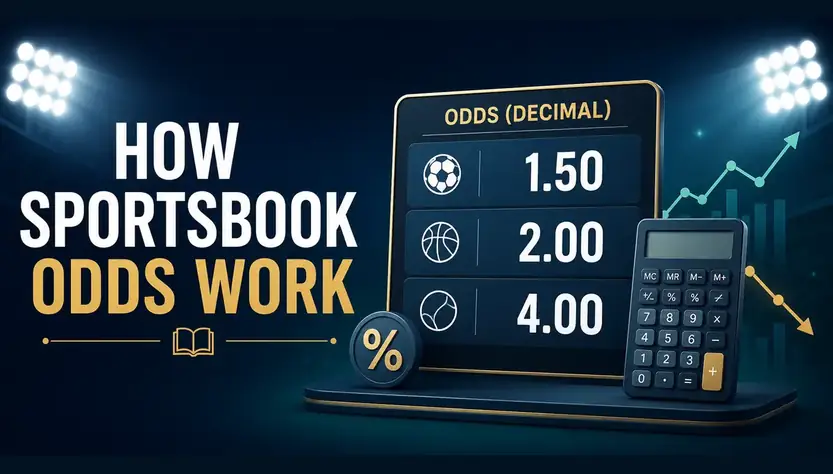
Sportsbook odds show both the implied likelihood of an outcome and the potential return from a successful wager. Learning how to read them can help you compare markets, understand risk and avoid making decisions based only on a large-looking payout.
This guide is educational. It does not promise winnings or recommend a gambling provider. Gambling involves financial risk, and no betting method can guarantee a profit.
What are sportsbook odds?
Odds are the numbers a sportsbook uses to price possible outcomes. They answer two basic questions:
- How likely does the market consider an outcome?
- What would the total return be if that outcome wins?
The displayed odds already include the sportsbook’s margin. This means the combined implied probabilities in a market will usually add up to more than 100%.
Decimal odds explained
Decimal odds are common across many international sports markets. They show the total return for every one unit staked, including the original stake.
Total return = stake × decimal odds
For example, a hypothetical $10 stake at decimal odds of 2.20 would produce a total return of $22 if successful. The potential profit would be $12 because the $10 stake is included in the return.
Decimal, fractional and American odds compared
The three common odds formats communicate the same underlying price in different ways. Understanding the equivalents makes it easier to compare information from different regions.
| Decimal | Fractional | American | Approximate implied probability |
|---|---|---|---|
| 1.50 | 1/2 | -200 | 66.7% |
| 2.00 | 1/1 | +100 | 50% |
| 2.50 | 3/2 | +150 | 40% |
| 4.00 | 3/1 | +300 | 25% |
Fractional odds
Fractional odds describe potential profit relative to the stake. At 3/2, a hypothetical two-unit stake would return three units of profit plus the original two-unit stake if successful.
American odds
Positive American odds show potential profit on a hypothetical 100-unit stake. Negative odds show the stake required to produce 100 units of potential profit. These are simply another representation of the same price.
Favourite and underdog odds
In decimal format, a lower number generally represents the market favourite and a higher number represents the underdog. A favourite is not guaranteed to win; the price only reflects a higher implied probability after the market margin is included.
Common mistakes beginners make
- Confusing total return with profit when reading decimal odds
- Treating implied probability as a certain prediction
- Ignoring whether overtime or extra time is included
- Comparing prices without checking that the market rules are identical
- Increasing a stake to recover a previous loss
How to calculate implied probability
You can convert decimal odds into an implied probability with this formula:
Implied probability = (1 ÷ decimal odds) × 100
- Odds of 2.00 imply a probability of 50%.
- Odds of 1.50 imply approximately 66.7%.
- Odds of 4.00 imply a probability of 25%.
Implied probability is a market estimate, not a prediction or guarantee. Injuries, team selection, weather and new information can cause prices to change.
Why odds move
Sportsbook odds can change before and during an event. Common reasons include:
- New information about injuries or player availability
- Changes in expected line-ups or tactics
- Weather and venue conditions
- Heavy betting activity on one side of a market
- Updates from related markets
A movement does not automatically mean that one outcome is certain. It simply shows that the market price has changed.
Common sportsbook market types
Moneyline or match winner
You choose which team or participant will win. Some sports include a draw as a third possible result.
Point spread or handicap
A virtual advantage or disadvantage is applied to an outcome. The adjusted result determines whether the selection is successful.
Totals
A totals market asks whether a combined statistic—such as goals, points or runs—will finish over or under a stated number.
Proposition markets
These markets focus on a specific event within a match, such as a player statistic or the first team to score. Rules can vary, so always read the settlement terms.
What is the sportsbook margin?
The margin is built into the offered prices. In a simple two-outcome market, both sides may be listed at 1.91. Each price implies about 52.36%, producing a combined total above 100%. The amount above 100% represents the approximate market margin.
Comparing prices can show how markets differ, but it cannot remove the underlying risk or guarantee a positive result.
Questions to check before making any decision
- Do you understand the exact market and settlement rules?
- Is overtime or extra time included?
- What happens if an event is postponed or abandoned?
- Can you afford to lose the entire amount without affecting essential expenses?
- Have you set a firm time and spending limit?
Legal considerations for Singapore readers
Singapore regulates remote gambling. The Gambling Regulatory Authority states that providing or participating in unlicensed remote gambling activities is unlawful, and identifies Singapore Pools as the only operator licensed by GRA to provide remote gambling services. Readers should review the official GRA guidance on unlawful remote gambling and confirm the current rules before taking part.
Responsible gambling basics
Treat gambling as paid entertainment, never as income or a way to recover losses. Set limits before starting, avoid borrowing money, and stop if gambling causes stress or interferes with work, relationships or daily responsibilities. People under the applicable legal age should not gamble.
Summary
Understanding sportsbook odds means knowing how to calculate returns, convert prices into implied probability and recognise the margin within a market. Odds describe a price—not certainty. Careful reading, realistic limits and awareness of local law matter more than any prediction.
For more educational information, visit our sportsbook guide or read the 88ProBet FAQ.